UX Design · Case Study · 2024–2026
This Is Your Moment
Redesigning a digital enrollment experience for newly accepted Drexel University students — from a legacy CMS to a modern, research-backed web experience.
Problem
Updating a legacy enrollment experience
A site built for 2020 being asked to perform in 2025.
- The site was built in 2020, a time when visiting campus was much more difficult than previously, or even today.
- Furthermore, it was built in our legacy system that needed to be updated.
Showcasing Drexel's value proposition and providing a clear call to action.
- Not every component from the old site existed in the new CMS.
- Our team asked, what would be relevant for visitors in ‘24-25 and beyond?
Goal
Conversion of accepted students into confirmed students.
Research
Audit, Insight, Design
The project unfolded in four distinct phases, each informing the next.
01
Content Mapping
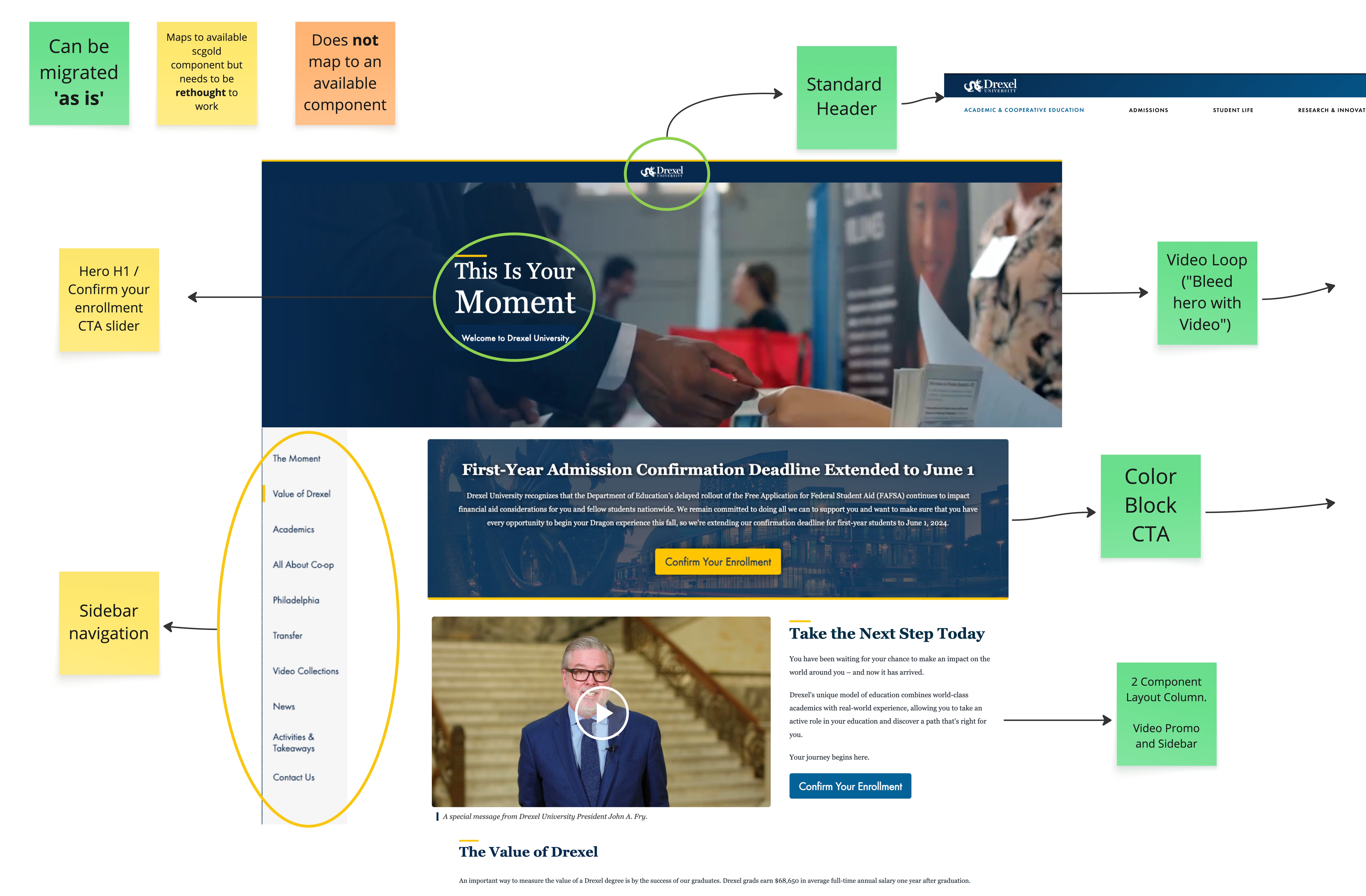
I discovered 3 high level components needed in the design, through a systematic audit and component mapping.
- A new Single Page Scroller Template
- In-page navigation via Anchor Links with Headings
- A Floating Action Button (FAB) to support quick enrollment actions throughout long scroll pages
02
Analytics
The data informed how our own emails heavily influenced traffic to certain areas of our site and at what times of year. This helped inform strategic decisions for several pieces of content strategy.
03
Usability Research
While the redesign took shape, I ran a moderated usability study with 9 participants, uncovering certain insights about previous iterations of the site structure and Users expectations.
04
UI Design
Here, I focused heavily on critical components necssary to the goal of the page, the Floating Action Bar, and jump links became a central design challenge, knowing it needed to be persistent, accessible and motivating without being intrusive.

/moment/ is heavily email-driven, spiking in mid-December and late March — the two peak enrollment decision windows. The page earned 23,337 views in the period, with /moment/activities/ and /moment/engineering/ as the most-visited subpages. These patterns directly informed content prioritization and the timing strategy for the Floating Action Bar.

Findings
What users told us we didn't expect to hear
The usability study confirmed some hypotheses and challenged others. Our core hypothesis — that primary buttons were not an effective navigation pattern for the variety of subpages on the site — was validated. But users surfaced additional friction points that pointed to deeper issues in information architecture and language.
Navigation by Button Isn't Enough
Users struggled to discover the range of subpages through primary CTA buttons alone. The variety of content — 13 Colleges and Schools plus experiential pages — needed a more flexible discovery mechanism than click-through buttons.
"Activities" Was a Misfire
The page titled "Activities" consistently confused participants. It didn't match their mental model — users were looking for student organizations, events, and campus life, but the label didn't signal that clearly.
The Copy Was Doing Too Much Work
Multiple users had difficulty parsing certain web copy. Abstract or passive language — when users are already excited but need clarity — became a barrier rather than a motivator. UX copywriting was identified as a critical gap.
The FAB Was Too Big on Mobile
The Floating Action Bar, designed to drive enrollment confirmations, was too visually dominant on smaller screens — obscuring content and creating friction rather than support. Sticky element sizing needed recalibration.
UX Writing Outcome
The findings sparked a larger conversation with the copywriting team about the distinction between microcopy (short functional labels) and micro-content (brief editorial moments). Both matter, but they require different approaches — and that distinction had been blurry in the original site.
Learnings
How we moved the project forward
User Understanding
Clearer picture of the audience
Developed a clearer picture of how newly accepted students navigate digital enrollment content — including what they prioritize (academics, Co-Op, campus life) and where they get lost.
Navigation Flexibility
Beyond button-only patterns
Identified and designed for users' need for more flexible in-site navigation — moving beyond button-only patterns to anchor links, a redesigned FAB, and improved IA.
Cross-Team Alignment
UX and Copywriting in the same room
Established a new working model for UX and Copywriting collaboration — ensuring UX-specific language decisions aren't made in isolation from the people who write the words.
Outcome
Final Designs
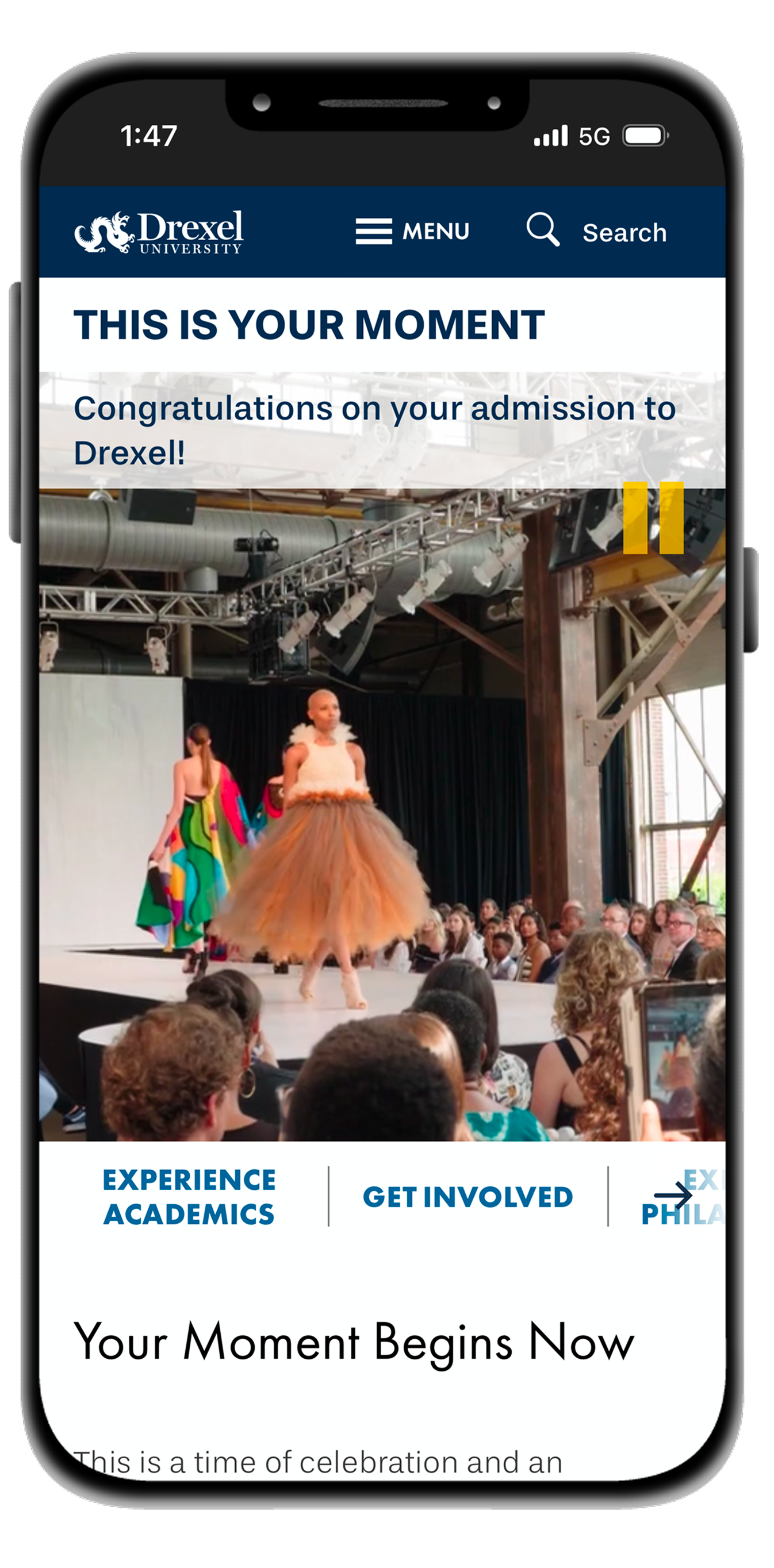
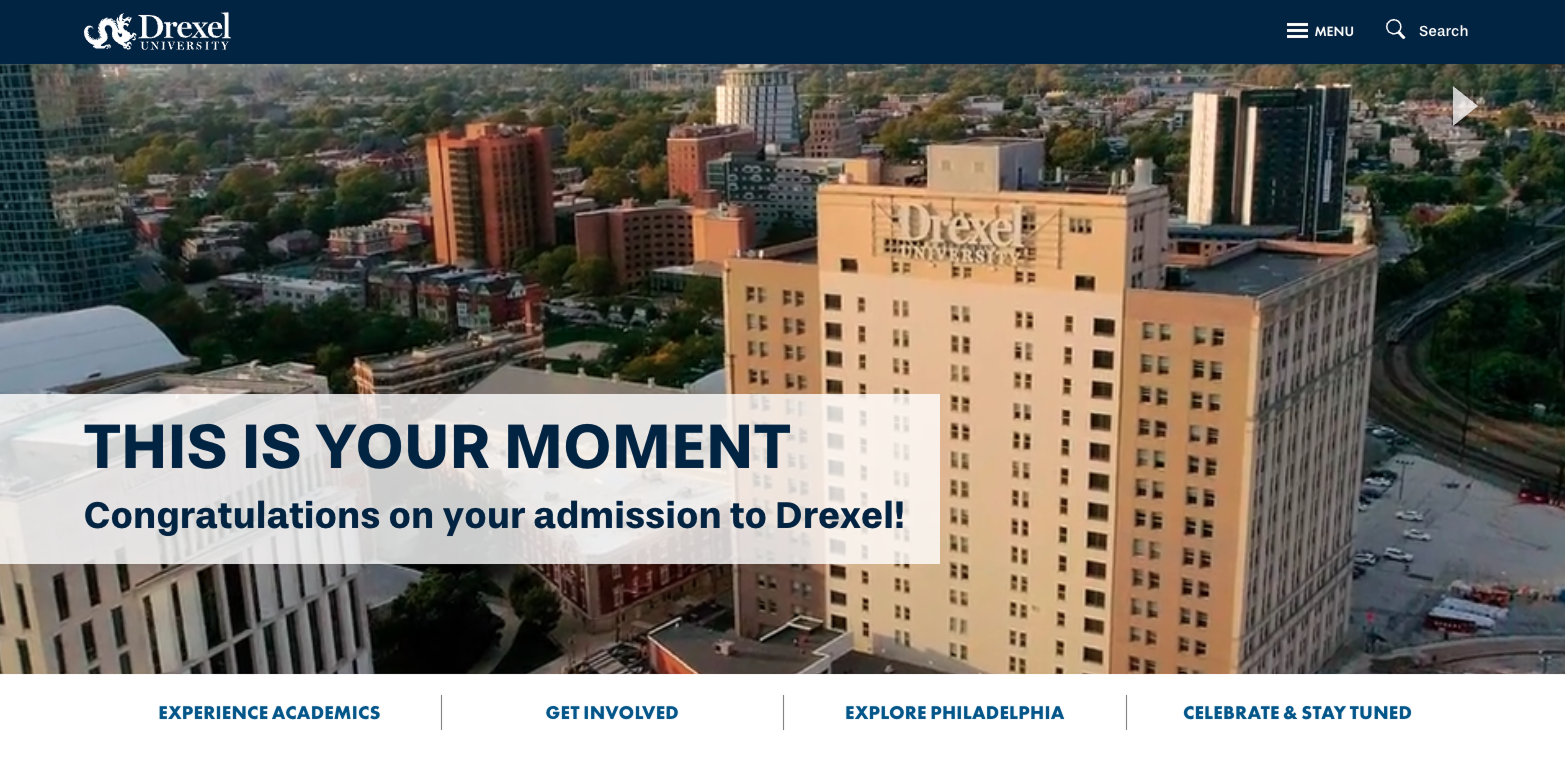
The final deliverable was a set of high-fidelity Figma mockups covering desktop and mobile breakpoints for all six page sections, along with a component library and annotated handoff specs for the development team.


